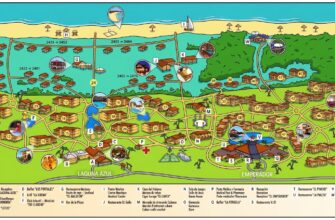
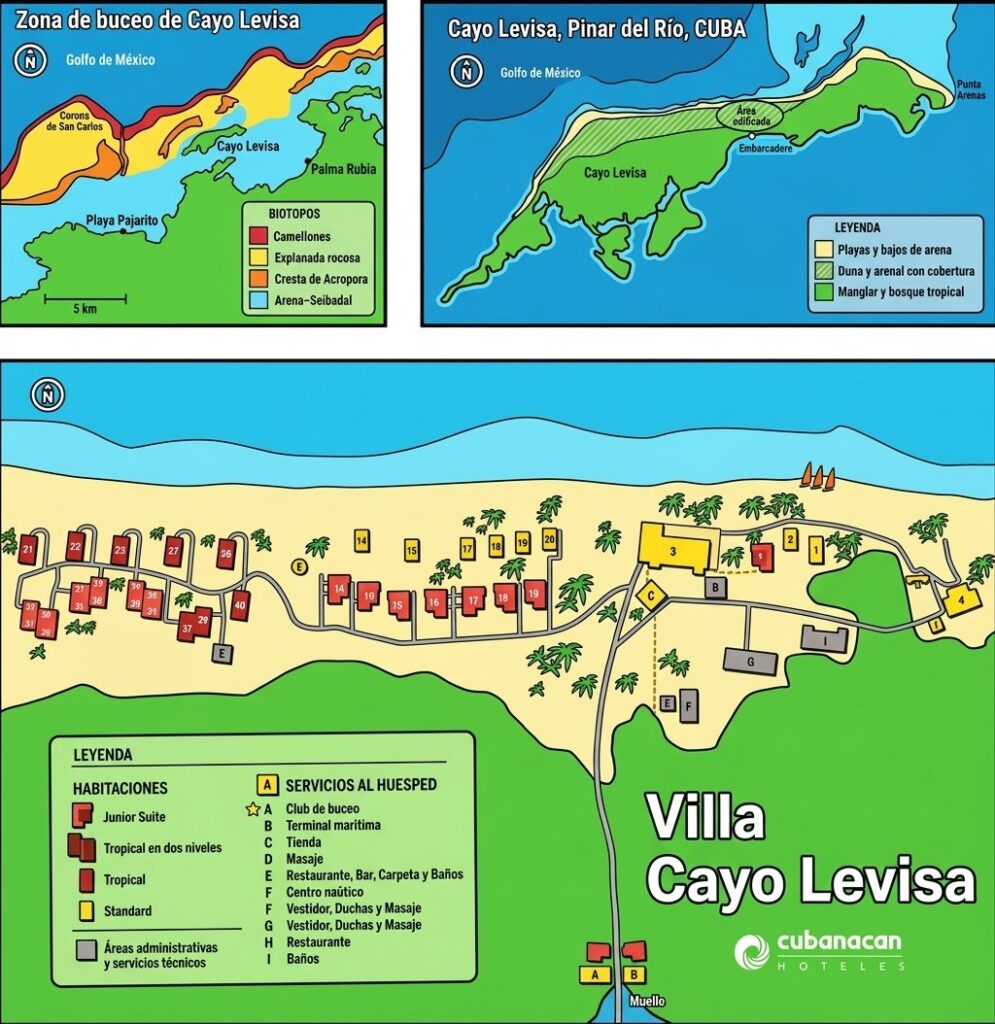
 Hotel Cayo Levisa Map property map – hotel layout and facilities guide” title=”Hotel Cayo Levisa Map resort map showing buildings, pools, restaurants and facilities” width=”995″ height=”1024″ loading=”lazy” />
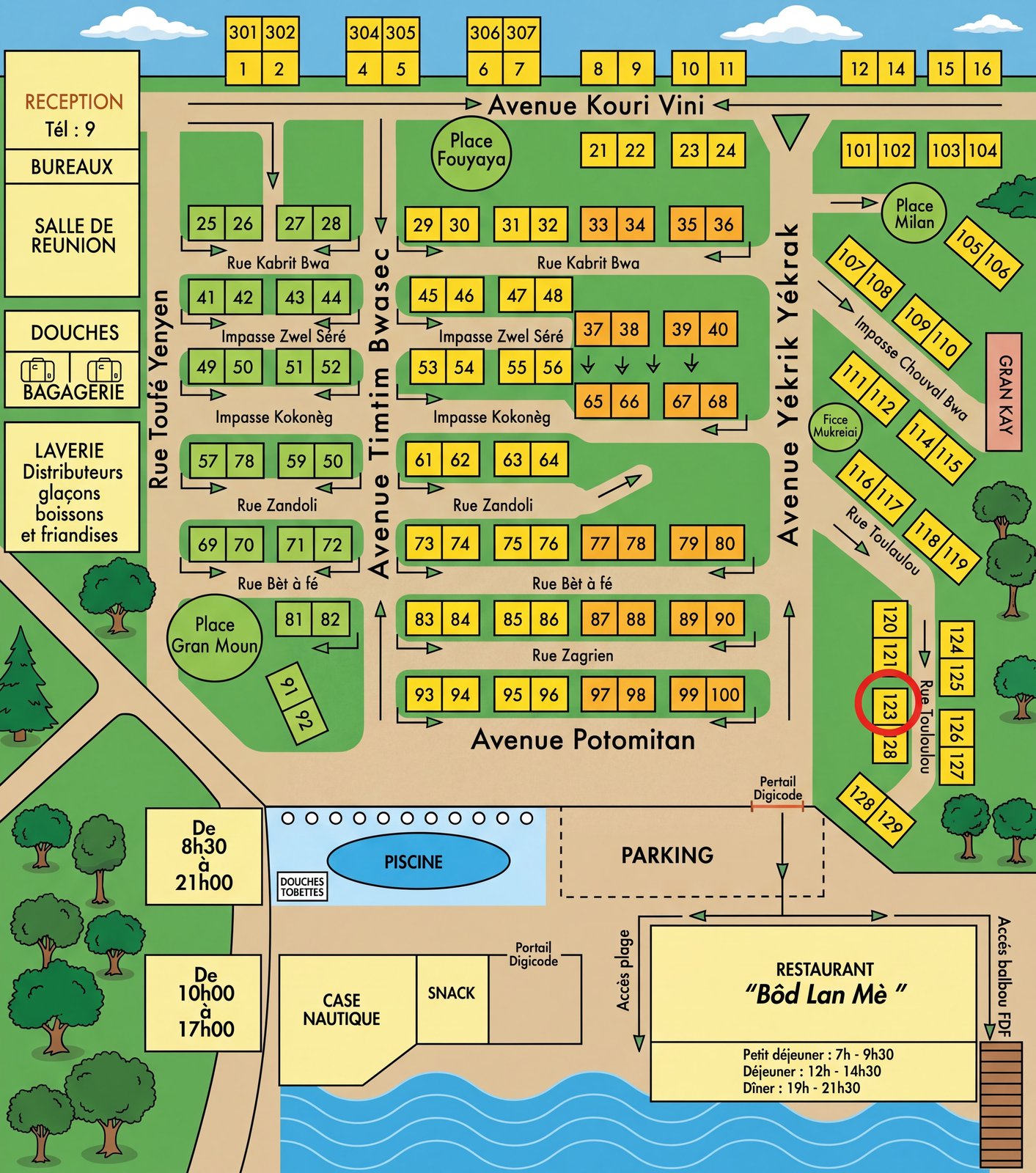
Map Legend
Accommodation
- Standard: Rooms 1–9, located on the eastern side of the property, closest to the main service hub (Building E).
- Tropical: Rooms 10–23 and 26–28, scattered across the western and central zones, many with direct beach proximity.
- Tropical en dos niveles: Rooms 24–25 and 29–42, two-level buildings clustered inland behind the Tropical units.
- Junior Suite: Yellow-orange bungalows on the far western end of the property, closest to the quietest stretch of beach.
- Áreas administrativas y servicios técnicos: Grey buildings interspersed among Tropical en dos niveles rooms — back-of-house, maintenance, and staff areas.
Dining
E. Restaurante, Bar, Carpeta y Baños: Main restaurant, bar, front desk, and bathrooms — the central hub of the resort, located mid-property. H. Restaurante: Second restaurant, positioned further east, closer to the beach and pier area.
Facilities & Guest Services
A. Club de buceo (Diving Club): Located on the Muelle (pier/dock), off the southeastern end of the main land. B. Terminal marítima (Maritime Terminal): Also on the Muelle — arrival and departure point for boats from the mainland. C. Tienda (Shop): Near the main complex E. D. Masaje (Massage): Adjacent to the main complex E. F. Centro naútico (Nautical Center): Close to the beach near the main complex, handles water sports rentals and coordination. G. Vestidor, Duchas y Masaje (Dressing Rooms, Showers & Massage): Eastern area, near the beach, between Buildings H and I. I. Baños (Bathrooms): Located near Building G, eastern beach zone.
Beach & Water Zones
- Main beach: Runs along the entire northern edge of the property facing the Golfo de México.
- Windsurfer zone: Active water area visible near the beach on the map — multiple boards depicted near the shoreline.
- Punta Arenas (Sandy Point): At the western tip of Cayo Levisa — a natural, less-developed sandbank area.
- Embarcadero (Pier): The southeastern dock connecting to the Terminal marítima (B) and Club de buceo (A).
Diving Zone (Zona de buceo de Cayo Levisa)
- Corona de San Carlos: Dive site north of Cayo Levisa in the Golfo de México.
- Palma Rubia: Nearby reference point on the mainland coast.
- Playa Pajarito: Coastal reference south of Cayo Levisa.
- Biotopes present: Camellones (mounds/ridges), Explanada rocosa (rocky plain), Cresta de Acropora (Acropora coral crest), Arena-Seibadal (sand-seagrass beds).
Where to Stay (Room Selection & Renovations)
Renovation Status
- The Junior Suites on the far western end consistently receive the best reviews for condition and comfort. Travelers describe them as the most well-maintained category on the property. If budget allows, this is the clear choice.
- Tropical rooms (single-level, red buildings) are older in construction but many guests accept the trade-off because of their closer beach position. Condition varies — rooms closer to Building E tend to be better maintained simply due to higher staff traffic.
- Tropical en dos niveles (rooms 29–42 in particular) sit furthest from the beach and have the most mixed reviews for upkeep. The upper-floor units get better airflow and feel less damp, which matters in a humid coastal environment. Request upper floor if booking this category.
- Standard rooms (1–9) are functional but plainly finished. Good for budget travelers who plan to spend most of the day outdoors. They’re well-located near the main hub but not on the beachfront.
- There is no confirmed major renovation since the hotel’s Cubanacan-era construction. Expect a rustic, classic Cuban beach resort feel throughout — not a polished international-chain finish.
Quiet & Sleep
- Junior Suites on the western end are the quietest. Distance from the main bar/restaurant complex (Building E) means no nighttime noise bleed.
- Avoid Tropical en dos niveles rooms directly adjacent to the grey administrative/technical service buildings — occasional early-morning generator or maintenance noise has been noted in reviews.
- The beach itself faces north toward the Golfo de México. Wind can be noticeable at night, which most guests find pleasant, but light sleepers should note it.
Convenience for Families
- Standard rooms (1–9) win on logistics: shortest walk to Building E (restaurant, bar, front desk, bathrooms), and relatively close to Buildings G and I (showers, bathrooms near the beach).
- Tropical rooms in the central zone (roughly rooms 13–19) offer the best compromise: close to the beach, not too far from the main services, and single-level (no stairs, good for strollers).
- Junior Suites are excellent for families wanting privacy and beach closeness, but the walk to the main restaurant is longer — factor that in for meal times with young children.
Top Spots & Hidden Gems
Guest Favorites
- The beach in front of the Junior Suites (western end) is repeatedly cited as the best stretch: wider sand, fewer people, calmer water. Walk there even if you’re not staying in that category.
- Building E (main restaurant and bar) is where social life happens, especially at the bar in the evening. The sunset view from this area looking west toward Punta Arenas is genuinely good.
- The Club de buceo (A) on the Muelle is the highlight for active travelers. Cayo Levisa sits next to one of the healthiest reef systems accessible from Cuba’s northwestern coast — the Acropora coral crests visible on the dive zone map are real and in good condition according to dive reviews. Book dives as early as possible after arrival; the operation is small and fills up.
Secret Locations
- Punta Arenas at the western tip of the island: walk the beach past the Junior Suites and you reach a natural sandy point with almost no other guests. It’s not a hotel facility — it’s just the end of the island. Bring water.
- The Muelle (pier) itself: outside of boat arrival/departure times, the dock is quiet and offers the best 360° view of the island and the surrounding water. Early morning on the pier before dive boats launch is genuinely special.
- The unidentified yellow circular icon on the western side of the property map (between Tropical rooms and the beach path) may indicate a beach bar or snack point — worth checking on arrival. Locals and staff often know of informal serving points not on official maps.
Dining Tips
- Building H (the second restaurant, eastern end) tends to be less crowded than the main restaurant in Building E. If you want a quieter meal, head there.
- Breakfast at Building E is the main event — the Cuban spread (fresh fruit, eggs, rice, coffee) is repeatedly praised in reviews. Arrive when it opens to get the freshest food and a table with a sea-facing view.
- The bar in Building E is known for strong, cheap mojitos and Cuban rum drinks. Travelers specifically flag the house rum cocktails as better value and quality than anything you’ll find at mainland tourist traps. Try the canchánchara if it’s offered — a traditional Cuban drink (honey, lime, aguardiente) suited to the setting.
- Seafood at dinner varies by catch — ask staff what came in that day rather than ordering blind from the menu.
Practical Layout & Distances
Key Walking Distances (approximate, based on resort map scale)
- Standard rooms (1–9) to Building E (main hub): Under 1 minute walk. Essentially next door.
- Tropical rooms (central, ~13–19) to beach: 30–60 seconds across the path.
- Tropical en dos niveles (rooms 35–42, far cluster) to beach: Approximately 3–4 minutes on foot through vegetation paths.
- Junior Suites (western end) to Building E: Approximately 5–7 minutes along the beach path. This is the longest walk on the property.
- Main property to Muelle (pier): The pier sits off the southeastern end, connected by a causeway. Budget 3–5 minutes from Building E.
- Building E to Building H (second restaurant): Approximately 2 minutes east along the beach path.
Terrain & Accessibility Notes
- The property is essentially flat. No hills, no significant elevation changes. Good news for strollers, wheelchairs, and guests with mobility concerns.
- The main path running parallel to the beach is unpaved (sand/gravel composite in most sections). Sandals are fine; rolling luggage may be slow.
- Tropical en dos niveles buildings, as the name states, have two levels with exterior stairs. No elevator exists. Upper-floor rooms require stair access — relevant for guests with mobility issues or heavy luggage.
- The causeway to the Muelle may be narrow. In wet conditions it can be slippery — noted in a few dive-related reviews.
- Dense tropical vegetation between building clusters means some interior paths are shaded but can feel enclosed. Not a negative — it’s part of the aesthetic — but first-time guests can get briefly disoriented. Orient yourself by always walking toward the sound and light of the beach (north).
Practical Shortcut
- The beach itself is the fastest route across the property east-to-west. Walking the waterline from Building H past Building G, past the Nautical Center (F), and west toward the Junior Suites is quicker than navigating the interior vegetation paths — and more pleasant.
Map FAQ
Q: Where exactly do boats arrive and depart? A: At the Terminal marítima (B) on the Muelle (pier), southeastern end of the property. The boat from Palma Rubia on the mainland arrives here. It takes roughly 30–40 minutes. Confirm departure times with the front desk (Building E) the evening before you leave.
Q: Is there a swimming pool? A: No. There is no swimming pool shown on the Property Map and no credible traveler report confirms one exists. The beach is the only swimming option. The water is calm and shallow, which compensates.
Q: Where do I check in? A: Front desk (Carpeta) is inside Building E — the large central building on the main map. It also houses the main restaurant, bar, and bathrooms.
Q: Where do I get towels for the beach? A: Typically from Building G (Vestidor, Duchas y Masaje) near the eastern beach zone, or from the front desk in Building E. Confirm with staff on arrival — the system can vary by season and staffing.
Q: How do I book a dive? A: Go directly to Building A (Club de buceo) on the Muelle. Do this on your first morning. The operation is small, spots are limited, and walk-ins the same day may not always be accommodated. Gear rental is available on-site.
Q: What water sports are available and where do I sign up? A: The Centro naútico (F), located near the main complex on the beach, handles water sports — windsurfing, kayaking, and potentially snorkeling equipment. The Hotel Layout map shows windsurfers active near the shore. Sign up at Building F.
Q: Is the western beach (near Junior Suites) accessible to all guests? A: Yes. The beach runs the full length of the property and is open to all guests regardless of room category. Non-suite guests frequently walk to the western end for the quieter environment.
Q: Are there any restaurants outside the hotel on the island? A: No. Cayo Levisa is a small, privately managed island. The only dining options are Buildings E and H within the Resort Layout. There are no independent restaurants or bars on the island.
Q: What’s the unidentified circular yellow icon on the western side of the map? A: The Resort Map shows an unmarked yellow circular symbol between Tropical rooms and the beach on the western side. Based on similar Cubanacan Resort Layouts, this likely indicates a beach bar or snack/drink point. Ask at the front desk — it may operate seasonally.
Q: How far is the loudest area (bar/music) from the quietest rooms? A: The main bar is in Building E, roughly central-east on the Hotel Map. The Junior Suites at the western end are the farthest point — approximately 5–7 minutes on foot. In practice, sound doesn’t carry that far through the tropical vegetation. Light sleepers in Tropical rooms 10–15 (closer to E) should use earplugs on busy nights.